


Introduction:
This course provides a concise and comprehensive body of knowledge on British literature and cultural history. Taking a journey into the history of British people and culture is an exciting enterprise of passing over enchanting moors of Scottish highlands, flying through ancient Celtic forests ruled by fairies and beholding dragons assailing high castles. It does not end in the realm of fantasy, myths and legends. Soon, the birth of science and philosophy follows, causing Copernican revolutions in politics, religion and morality. The Renaissance brings back the Classical teaching and ‘Man’ into the center of English life. Thus, the early modern mentality is born and expands rapidly.
To get to know this realm, we will be reading Beowulf as well as selected works by Chaucer, Spenser, Sidney, Shakespeare, Donne, Herbert, and Milton, Pope, Swift, Locke, Coleridge, Lord Tennyson, Anna Laetitia Barbauld, Mary Wollstonecraft, Charlotte Smith, Virginia Woolf, T. S. Eliot, McCarthy, Vonnegut, and so forth. We will explore words and images created by geniuses, likes of whom are rare to be found in other realms and ages.
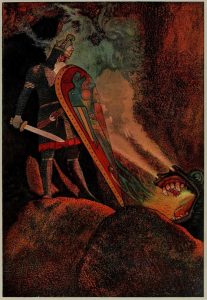
Beowulf facing the dragon
A Description of Objectives and Methods:
In the first part of this course, a survey of Medieval, Renaissance, Restoration and the 18th century English literature is focusing on selected authors, genres, and forms. The second part of this course, featuring authors and texts of their works from the Romantic Period to the 20th Century, will connect you to literature’s captivating discourse, featuring: • Contextualizing the Romantic, the Victorian eras and the Twentieth Century and beyond • Use of images and paintings • Introducing authors influential in each period • Reading and Review Questions • Analysing M. A. Concours tests
So, naturally, major figures and pieces are going to be discussed and addressed. You will become acquainted with influential texts in relation to specific political, cultural, and technological contexts. We will cover topics such as love and sexual transgression, spiritual experience, monarchy’s power and church authority, performance and court politics, and the changing status of the English culture and society. We will be reading instances of different literary forms and compositions (i.e., prose, poetry, and drama) and analyzing the ways in which they are created to bring about specific effects. How texts worked to charm, enchant, surprise, comfort, persuade, provoke or even agitate readers will be another set of goals for us. Questions similar to the following items may also be raised and discussed: What were the attitudes towards literary representation itself? What were the possible roles of literature? How did literary activity and creativity affect politics, social affairs and religious concerns? Questions regarding gender, class, race and ethnicity are going to be considered as well.
Of the most important aims of this course is to increase your understanding and enjoyment of literary texts, sharpening your sense of the cultural dynamics of different periods of English literature. This course will also include poetical or textual analyses because of the highly motivational and important content of a course on the history of English literature. Therefore, several samples of poetry or prose will be read and analyzed in the class.
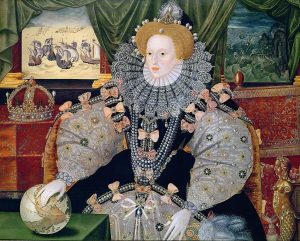
The Armada Portrait of Elizabeth I, artist unidentified.
Schedule 1st Session: • History of Old English Literature. Anglo-Saxon Literature, Anglo-Norman Literature. 2nd Session: • Middle English Literature in the Fourteenth and Fifteenth Centuries, Medieval English, Old and Middle English Prosody, Beowulf. 3rd Session: • Beowulf lines: 1-100. • Sir Gawain and The Green Knight, Geoffrey Chaucer. 4th Session: • The Canterbury Tales: The General Prologue. • Julian of Norwich. Sir Thomas Malory and his Morte Darthur. 5th Session: • The Sixteenth Century (1485-1603), The Court and the City, Renaissance Humanism, The Reformation and A Female Monarch in A Male World, Sir Thomas More, The Kingdom in Danger, The English and Otherness. 6th Session: • Tudor Style, the Elizabethan Theater and Surprised By Time, Henry Howard, Earl of Surrey, Faith in Conflict. 7th Session: • Women in Power, Mary Queen of Scots, Elizabeth I, The Golden Speech, Edmund Spencer, Introduction to The Faerie Queene. 8th Session: • The Faerie Queene, Renaissance Love and Desire, Sir Phillip Sydney and Astrophil and Stella. • Christopher Marlowe and Dr. Faustus.
9th Session: • William Shakespeare and Twelfth Night. • King Lear and the Early Seventeenth Century, State and Church. 10th Session: • Literature and Culture and Caroline Era, John Donne and ‘The Canonization’. • The Revolutionary Era and Literature and Culture and Ben Jonson, Volpone. 11th Session: • Mary Wroth, John Webster, Gender Relations: Conflict and Counsel. • George Herbert, Andrew Marvel, Crisis of Authority, Political Writing and John Milton. 12th Session: • Paradise Lost. • The Restoration and the Eighteenth Century, Religion and Politics and John Dryden. 13st Session: • Conditions of Literary Production and Literary Principles • Restoration Literature, 18th Century Literature 1700-1745, The Emergence of New Literary Themes and Modes 1740-1785 and Continuity and Revolution. John Locke. 14th Session: • Aphra Behn, Mary Astell, Anne Finch, Lady Mary Wortley Montagu. • Johnathan Swift and Gulliver’s Travels. 15th Session: • Alexander Pope and Debating Women in Verse. • Samuel Johnson. 16th Session: • The Romantic Period 1785-183, Balladry and Ballad Revivals. • Anna Letitia Barbauld, The Mouse’s Petition. 17th Session: • Charlotte Smith, Elegiac Sonnets. • William Wordsworth and Samuel Taylor Coleridge, Lyrical Ballads. 18th Session: • Dorothy Wordsworth. • Mary Robinson, ‘London’s Summer Morning’. 19th Session: • Shelley, ‘Mont Blanc’. • Byron, Manfred, a dramatic poem. 20th Session: • Keats, “The Eve of St. Agnes”. • Felicia Dorothea Hemans, “The Homes of England”. 21st Session: • Marry Shelley, Frankenstein. • Mary Wollstonecraft, A Vindication of the Rights of Woman. 22nd Session: • Maria Edgeworth, The Irish Incognito. • The Gothic and the Development of a Mass Readership 23rd Session: • Ann Radcliffe The Romance of the Forest. • Letitia Elizabeth Landon, ‘The Proud Ladye’. 24th Session: • The Victorian Age, Victorian Temper and Early Period • Middle Victorian Period. 25th Session: • Late Victorian and the Nineties. • Role of Women. • Literary Genres. 26th Session: • Carlyle, Newman, Mill. • Elizabeth Barrett Browning, Aurora Leigh. • Lord Tennyson, ‘The Lady of Shalott’. 27th Session: • Robert Browning, ‘My Last Duchess’. • Emily Bronte, ‘To Imagination’. 28th Session: • George Eliot. • Matthew Arnold. 29th Session: • Rossetti Siblings, ‘Jenny’, ‘Goblin Market’. • Oscar Wilde, The Picture of Dorian Gray. 30th Session: • Elizabeth Gaskell. • Mary Elizabeth Coleridge. 31st Session: • The Twentieth Century: Context • Modernism • Poetry 32nd Session: • Drama, Fiction. • Postmodernism and Metamodernism 33rd Session: • Thomas Hardy, ‘Darkling Thrush’. • Voices from World War I. 34th Session: • Ezra Pound, Cantos. William Butler Yeats, ‘The Stolen Child’. • H. D. ‘Oread’. 35th Session: • Voices from World War II. • Virginia Woolf, ‘A Room of One’s Own’. • James Joyce, Ulysses. 36th Session: • T. S. Eliot, The Waste Land. • Stevie Smith. • Samuel Beckett, Waiting for Godot. 37th Session: • Doris Lessing, Through the Tunnel. • Kiran Desai, 38th Session: • Seamus Heaney. • W. H. Auden, ‘The Shield of Achilles’.
39th Session: • Chinua Achebe, Things Fall Apart. • Alice Munro, ‘Walker Brothers Cowboy’. 40th Session: • Harold Pinter, The Dumb Waiter. • Anne Carson. ‘Hero’.
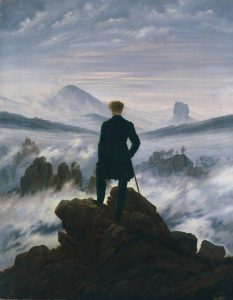
The Wanderer above the Sea of Fog, Caspar David Friedrich
Required Text: Volumes A, B, C, D, E, F of The Norton Anthology of English Literature, 9th ed. (New York: Norton, 2012). Secondary Sources: Volumes 1, 2 and 3 of Black, Joseph. The Broadview Anthology of British Literature. Peterborough: Broadview Press, 2015. Milne, Ira Mark. Literary Movements for Students Presenting Analysis, Context and Criticism on Literary Movements. Detroit: Gale, 2009.
دکتر علی قادری



صدها ساعت آموزش
دسترسی به مجموعهای گسترده از دورهها و کارگاههای تخصصی زبان و ادبیات انگلیسی؛ از مقدماتی تا پیشرفته، طراحیشده برای یادگیری عمیق و کاربردی.

دسترسی آنی و همیشگی
مطالب آموزشی همیشه در دسترس شماست تا هر زمان بخواهید مرور، یادگیری و تمرین کنید.

دورههای تخصصی
مجموعهای از آموزشهای هدفمند و عمیق در حوزه زبان و ادبیات انگلیسی، طراحیشده برای ارتقای مهارتهای حرفهای و پژوهشی زبانآموزان.

تضمین کیفیت آموزشها
تمامی دورهها با دقت علمی، ارزیابی تخصصی و استانداردهای آموزشی روز طراحی شدهاند تا یادگیری شما اثربخش، ماندگار و قابل سنجش باشد.
دیدگاهها
هیچ دیدگاهی برای این محصول نوشته نشده است.