


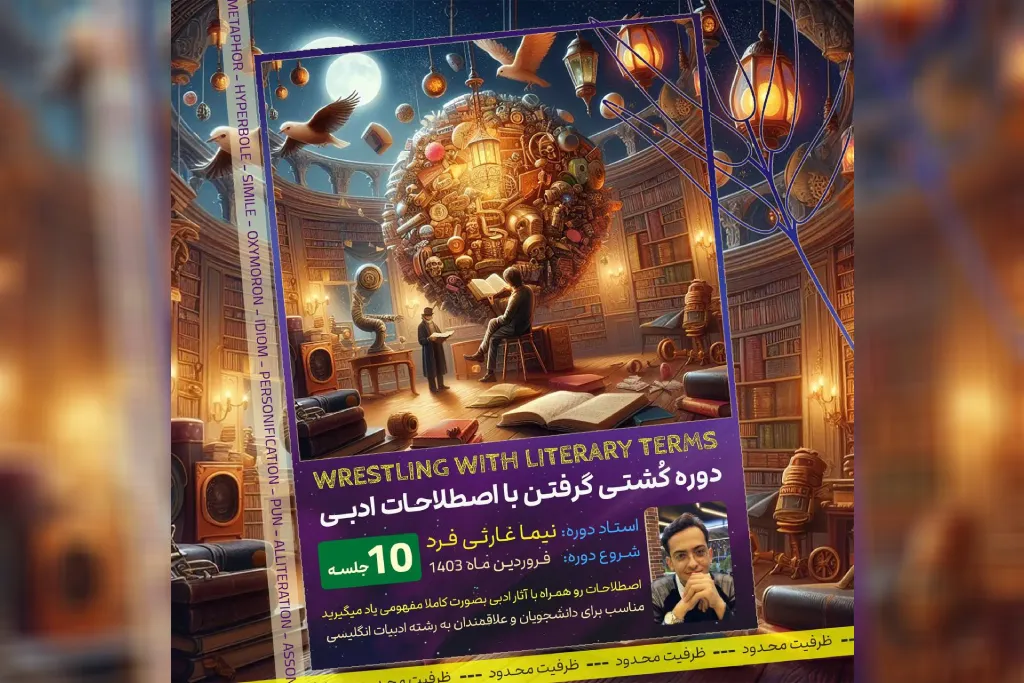
دوره اصطلاحات ادبی
در این دوره، اصطلاحات ادبی بهصورت مفهومی و کاربردی آموزش و با تحلیل آثار شاخص ادبی جهان پیوند داده میشوند. جلسات دوره بهصورت تعاملی و جذاب برگزار میشوند تا فراگیران اصطلاحات را در زمینههای واقعی و متون ادبی تمرین و تثبیت کنند. این رویکرد عملی و تحلیلی، درک عمیق و کاربردی اصطلاحات ادبی را برای دانشجویان و علاقهمندان فراهم میکند.
قیمت دوره:
تماس بگیرید
نوع دوره
زمان دوره
تعداد جلسات
سطح دوره
وضعیت دوره
بروزرسانی
توضیحات
کدام یک از جملات شرح حال شماست؟
- نمیتوانم اصطلاحات ادبی را در آثار شناسایی کنم.
- در دانشگاه به خوبی درس فنون صناعات (اصطلاحات ادبی) را یاد نگرفته ام.
- دارم روی پایان نامه یا آثار ادبی کار میکنم و باید به اصطلاحات ادبی مسلط باشم.
- به آثار ادبی و هنری علاقه دارم و میخواهم آنها را دقیق تر و کاربردی تر یادبگیرم.
- مشغول نوشتن مقاله هستم اما به دلیل اینکه تسلط کافی روی مباحث اصطلاحات ندارم ساعت های طولانی مجبور به مطالعه کتاب های تحلیلی میشم.
دستـاوردهــای حضــور در دوره Literary Terms
در ایـن دوره قـرار است با تحلیل آثار معروف به یادگیری اصطلاحات ادبی بپردازیــم
- ذکر نکات مهم و معرفی دقیق اصطلاحات
- بازیابی اصطلاحات در آثار ادبی که نشانگر آنها باشند
- تسلط کامل بر اصطلاحات ادبی
- توانایی شناسایی ویژگی اصطلاحات در آثار ادبی
- پاسخگویی به سوالات اصطلاحات ادبی در کنکور
Course Overview
This course takes a more appealing approach to the study of literary terms. The summa of the
method is that the technical discussions of the terms are studied in parallel with exciting literary
texts which embody the term under discussion. The lectures aim to introduce students to the
concepts and terminology of literary analysis, and aspires for aha moments of epiphanic
understanding while exploring literary texts.
Course Objectives
The aim of this course is for the students to be able to
1. Create works of art with an awareness of essential literary terms;
2. Read literature pieces with a keen eye for the underlying techniques that the texts use to
create their unique effect;
3. Understand a number of the main literary terms and identify them by their characteristics.
4. Analyze and interpret literary texts using appropriate literary terms and concepts
5. Compare and contrast the use of literary terms across genres and periods
6. Write clear and coherent essays that demonstrate the understanding and application of
literary terms
Required Reading
Main source:
Baldick, Chris. The Concise Oxford Dictionary of Literary Terms. 2nd ed., Oxford UP, 2004.
Subsidiary Sources:
Pier Paolo Pasolini’s “The Canterbury Tales;” Chaucer’s
masterpiece includes an important piece of the beast fable
The mythological shapeshifter Proteus who appears
in Odyssey, a quintessential epic.Greenblatt, Stephen, et al., editors. The Norton Anthology of English Literature, 10th ed., W. W.
Norton, 2018.
Leitch, Vincent B., et al., editors. The Norton Anthology of Theory and Criticism. 2nd ed., W. W.
Norton, 2010.
Ferguson, Margaret, et al, editors. The Norton Anthology of Poetry, 5th ed., W. W. Norton, 2004.
Levine, Robert S., general editor. The Norton Anthology of American Literature, 9th ed., W. W.
Norton, 2016.
Further sources will be introduced as the course progresses.
Tentative Schedule
Lecture 1:
I C! Anagnorisis
The Absurd, Alliterative Verse, Aestheticism, Verfremdungseffekt, American Renaissance,
Anachronism, anagnorisis, analepsis, anaphora and cataphora, anatomy, Angry Young Men,
Angst, anticlimax, anxiety of influence, Apollonian/Dionysian, aporia, apostrophe, archetype, l’art
pour l’art, aubade, autotelic
Lecture 2:
The Anxiety of Influence
Ballad (cluster), beast fable, beat writers, bildungsroman, bodice-ripper, bowdlerize, burlesque,
cacophony, carpe diem, catachresis, catastrophe, catharsis, chanson de geste, claque,classicism, climax, closet drama, collage, comedy/tragedy/tragicomedy/cometragedy, commedia
dell’ arte, confessional poetry, coup de theatre, courtly love, crux, cultural materialism
Lecture 3:
The Canon
Dada, decadence, deconstruction, deep structure, ostranenie, denouement, deus ex machina,
diegesis, dirge, dirty realism, dramatic monologue, dystopia, ecriture, eiron, encomium, envelope,
envoi, epic theatre, existentialism, extempore, eye rhyme,
Lecture 4:
Tragicommodification!
The fantastic/the uncanny, fin de siecle, frame narrative, free indirect style, vers libre, Futurism,
ghazal, graveyard poetry, grotesque
Lecture 5:
I am a sinner! Confessional Poetry
haiku, hamartia, Harlem Renaissance, hermeneutic circle, horizon of expectations, idiolect,
Imagism, in medias res, intentional fallacy, interior monologue, intertextuality, jouissance
Lecture 6:
The DramaticKünstlerroman, lai, lament/ubi sunt, leitmotif, leonine rhyme, libretto, light verse, limerick, lisible/
scriptible, literariness, litotes, local color writing, logocentrism, macaronic verse, Machiavel,
madrigal, magic realism, metafiction, metaphysical poets, mise-en-abyme, modernism, morality
play, the Movement
Lecture 7:
Epic(/)Theatre
naturalism, negative capability, negritude, nonsense verse, objective correlative, omniscient
narrator, pastoral, pathetic fallacy, peripeteia, phenomenology, picaresque novel, plot, poete
maudit, polyphonic, postcolonial literature, postmodernism, structuralism/post-structuralism,
prose poem, psychomachy
Lecture 8:
Deus Ex Machina In Medias Res
reader-response criticism, Rezeptionsasthetik, rhapsody, rococo, romantic comedy, Romanticism
Lecture 9:
S&F
S & F, the semiotic, sonnet, short story, Spasmodic School, Spenserian stanza, stichomythia,
story, stream of consciousness, Sturm und Drang, the sublime, subplot, Surrealism, Symbolists,
tableau, terza rima, theatre in the round, theatre of cruelty, first-person/third-person narrative,
thesis, Transcendentalism, trilogy, triplet, troubadour/trouvere
Lecture 10:
Theatre of Cruelty
The unities, unreliable narrator, utopia, vraisemblance, verse paragraph/stanza, villanelle, volta,
Vorticism, Weltanschauung, Weltschmerz, West End, Zeitgeist
اساتید دوره / کارگاه
