


A Course Syllabus for History of Literary Theory and Criticism: From Plato to Metamodernism

The School of Athens by Raphael
Course Overview
Literary theory and criticism are sibling branches that go hand in hand with literature. Without a doubt, they both are also as old as literature herself. It is certain that ancient poets, say Homer, had their critics. Homer, as many other ancient and modern poets tend to, invokes the muses. This act in itself is a theory of poetry. The muses are invoked at the beginning epics of Homer or the likes of him. This is a theory that posits poetry as an artistic utterance inspired by the divine. Plato calls the same notion divine madness. Aristotle later challenged this; emphasizing the sophistication and necessity of verbal art. Later, he brought forth the most famous and most efficient theory of poetics and tragedy. We will discuss critics, philosophers, and poets who contributed significant efforts to answer the following queries: “What is good literature? What is literature good for? How are we to interpret literature? What is the relationship between author, text, reader, and world?” Texts from classical, neoclassical, Romantic, Victorian, Modernist, and Postmodernist traditions and contemporary trends will be introduced and perused. In choosing these texts two criteria have been considered: First, they are pivotal texts of their respective literary traditions; in some cases, they inaugurated or influenced certain traditions significantly. In several historical discourses, they are the high points. The second reason is that some of these texts are still shaping the discourse of literary criticism/theory.
The philosopher Pyrrho of Elis
Course Objectives/Outcomes
Performance quality in this course is highly dependent on two pivotal factors. First, instructor’s competence, strategy and choice of reading materials. Second, student’s comprehensive close reading of the given materials. If these two are achieved, the course will be able to approximate the following outcomes:
• Students will be able to grasp a clear understanding of important texts in the history of theory and criticism.
• Students’ faculty of critical thinking will grow to reach a certain level of sophistication so as to peruse and read texts of literature critically. But reading and analyzing texts is the eventual outcome of this course not the immediate one.
• We will have an understanding of historical attitudes toward literature. This is important for comprehending current issues in literary theory, and for use in the classroom/research. How theory and criticism has shaped the field of literature and other related fields is another objective.
Book Required:
Leitch, Vincent B. Norton Anthology of Theory and Criticism. Norton & Company Limited, W. W., 2018. Third edition
Major Sources:
1. The Cambridge History of Literary Criticism (Volumes One to Seven), Cambridge: Cambridge University Press, 2011.
2. The History of Literary Criticism from Plato to the Present, M. A. R. Habib, Oxford: Blackwell, 2005.
3. An Introduction to Literary Criticism. Richard Dutton. Longman, 1984.
4. A Short History of Literary Criticism. Vernon Hall. The Merlin Press, 1963.
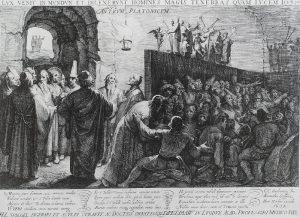
Plato’s allegory of the cave, Jan Saenredam, according to Cornelis van Haarlem, 1604.
Suggestions for Further Readings:
Eagleton, Terry. Literary Theory an Introduction. University of Minnesota Press, 2008.
⃰indeed more books, papers, and other materials will be mentioned during the course. Yet, these two are primary for every literature student. There will be some parts of these two’s content delivered during the course, and only a small portion of these parts are going to be on your final exam.
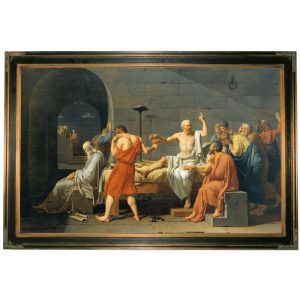
The Death of Socrates by Jacques-Louis David
Schedule
*The contents of these sessions are susceptible to minor to substantial changes.
Session 1: Course Introduction, Classical Criticism, Pre-Socratic Masters
Session 2: Classical Criticism, Gorgias of Lentini, Encomium of Helen
Session 3: Classical Criticism, Plato, from Republic, Ion, and Phaedrus
Session 4: Classical Criticism, Aristotle, from Poetics
Session 5: Classical Criticism, Horace, The Art of Poetry
Session 6: Classical Criticism, Longinus, from On the Sublime
Session 7: Christian Thought, Augustine of Hippo, On Christian Teaching
Session 8: Medieval Era, Dante, from Letter to Can Grande della Scala
Session 9: Medieval Era, Aquinas, Summa Theologica
Session 10: Renaissance and Seventeenth Century, Sidney, An Apology for Poetry
Session 11: Renaissance and Seventeenth Century, Aphra Behn, Epistle to the Reader
Session 12: Eighteenth Century, Samuel Johnson, The Rambler, [On Fiction]
Session 13: Eighteenth Century, Kant, Analytic of the Sublime
Session 15: Eighteenth Century, Hume, Of the Standard of Taste + Barbara Herrnstein Smith
Session 16: Romanticism, Schiller, from On Naïve and Sentimental Poetry
Session 17: Romanticism, S. T. Coleridge and Wordsworth, the Preface
Session 18: Romanticism, Shelley, Defence of Poetry +Raymond Williams
Session 19: Nineteenth Century, Hegel, Introduction to the Philosophy of Art
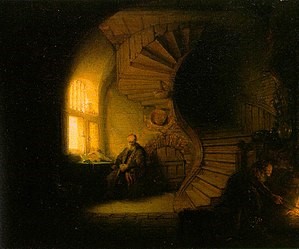
Philosopher in Meditation (or Interior with Tobit and Anna) by Rembrandt
Session 20: Nineteenth Century, Wollstonecraft, from Vindication
Session 21: Nineteenth Century, Arnold, Function of Criticism
Session 22: Nineteenth Century, Marx and Engles, Capital and Grundrisse
Session 23: Nineteenth Century, Oscar Wilde, Preface to The Picture of Dorian Gray
Session 24: Modernism, Eliot, Tradition and the Individual Talent
Session 25: Modernism, Woolf, A Room of One’s Own
Session 26: Modernism, Auerbach, Odysseus’ Scar
Session 27: Modernism, Gramsci, The Formation of the Intellectuals
Session 28: Modernism, Benjamin, The Work of Art in the Age of Its Technological Reproducibility
Session 29: Formalism, Shklovsky, Art as Technique
Session 30: Poststructuralism and Deconstruction, Barthes, Death of the Author
Session 31: Bakhtin, Discourse in the Novel + Cleanth Brooks
Session 32: Frankfurt School, Adorno and Horkheimer, The Culture Industry: Enlightenment as
Mass Deception
Session 33: Poststructuralism and Deconstruction, Derrida, Structure, Sign, and Play; The Father of Logos
Session 34: Postmodern Thought, Deleuze and Guattari, From Introduction: Rhizome
Session 35: Postmodern Thought, Psychoanalysis of Zizek, Looking Awry: An Introduction to Jacques Lacan through Popular Culture
Session 36: Postcolonialism, Said, Orientalism
Session 37: Feminism, Cixous, The Laugh of the Medusa
Session 38: Cyborgs, Haraway, A Manifesto for Cyborgs
Session 39: Gender and Sexuality, Butler, Subversive Bodily Acts
Session 40: After Theory and Critical Making, Jagoda
Session 41: After Theory and Critical Making, Felski
Session 42: Morton, The Ecological Thought
Session 43: Metamodernism and the future of theory, Jason Ananda and Josephson Storm, Metamodernism: The Future of Theory
Session 44: Video Games, Bogost, The Rhetoric of Video Games
Session 45: Braidotti, The Posthuman
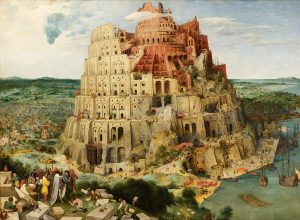
The Tower of Babel by Pieter Bruegel the Elder

دکتر علی قادری






صدها ساعت آموزش
دسترسی به مجموعهای گسترده از دورهها و کارگاههای تخصصی زبان و ادبیات انگلیسی؛ از مقدماتی تا پیشرفته، طراحیشده برای یادگیری عمیق و کاربردی.

دسترسی آنی و همیشگی
مطالب آموزشی همیشه در دسترس شماست تا هر زمان بخواهید مرور، یادگیری و تمرین کنید.

دورههای تخصصی
مجموعهای از آموزشهای هدفمند و عمیق در حوزه زبان و ادبیات انگلیسی، طراحیشده برای ارتقای مهارتهای حرفهای و پژوهشی زبانآموزان.

تضمین کیفیت آموزشها
تمامی دورهها با دقت علمی، ارزیابی تخصصی و استانداردهای آموزشی روز طراحی شدهاند تا یادگیری شما اثربخش، ماندگار و قابل سنجش باشد.
نقد و بررسیها
هنوز بررسیای ثبت نشده است.